A Chrome extension I designed and built to make speaking time visible during Google Meet calls — a live fair-share line for facilitators and a personal talk-time chip for everyone else, so no single voice accidentally takes over the room.
Client
Personal Project
Category
Browser Extension · Product
Contributions
- Product Design
- Chrome Extension (MV3)
- TypeScript
- DOM Instrumentation
- Real-time UI
- Vite Build
- Store Listing & Branding
Project Link
The problem
Most meetings have a quiet imbalance running underneath them, and almost nobody can see it in the moment.
I noticed it first in myself. I'd leave a call replaying it in my head — did I just talk for ten minutes straight? — with no way to have known while it was happening. By the time you feel it, the moment to ease off has already passed.
Then I started noticing the same thing across the room. In a roundtable or a Q&A, one person genuinely engaged — not rude, just enthusiastic — would accidentally spend the entire question budget, and three people who'd been waiting for a gap simply never got one. The quietest, most considered perspectives are often the ones that never make it into the conversation, and the facilitator usually only realizes once the meeting is already over.
The nuance that mattered: imbalance isn't always bad. A presentation is supposed to be one voice. A demo, a readout, a status update — one person should dominate. The goal was never "make everyone talk equally." It was to make the split visible, so a facilitator can tell the difference between a presentation and an attendee accidentally clobbering everyone else's airtime — and gently steer.
What I wanted to build
A live, glanceable signal of who's been speaking and for how long, that:
- works inside a normal Google Meet call, with no setup,
- gives facilitators a fair-share reference for the whole room,
- gives each attendee a quiet, private nudge about their own airtime, and
- records nothing off the device — no transcripts, no audio, no accounts.
What I built
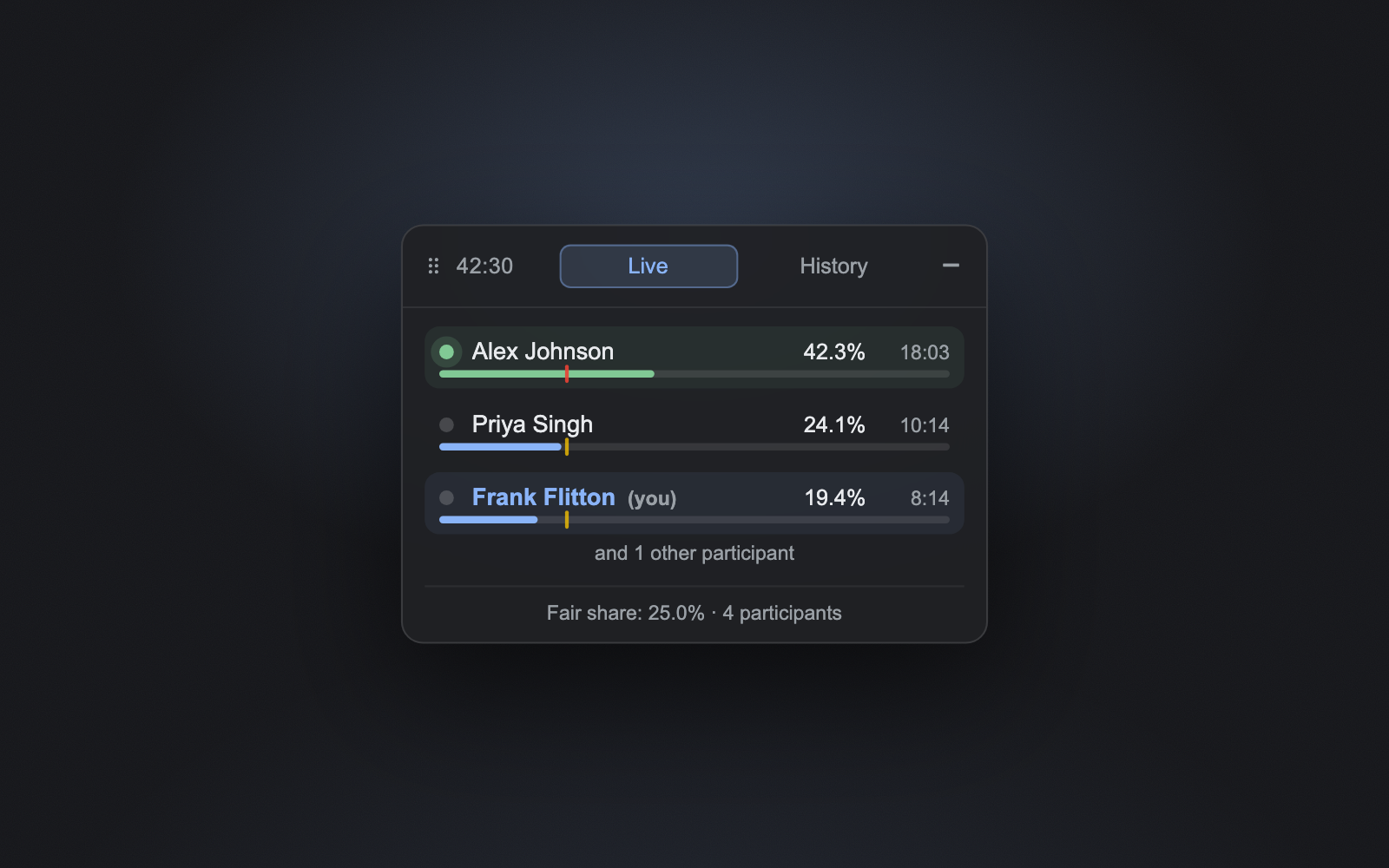
Airtime is a Chrome extension that adds a live panel to any
meet.google.com call. Each participant gets a bar and a percentage, and a
"fair share" line marks what an even split would look like — so it's obvious
at a glance whether the room is balanced, or whether one voice is running away
with it.
It deliberately works at two zoom levels, because the two problems are different:
- For the room. The fair-share marker gives a facilitator an at-a-glance read: who's been quiet, who's over, and whether the imbalance is the expected one (a presenter) or an accidental one (an attendee eating all of Q&A). That's the cue to make space — "let's hear from someone we haven't yet."
- For you. The panel collapses to a single chip showing just your own talk-time %. No watching everyone else — just enough self-awareness to ease off or lean in, while it's still useful.
How it works
There's no microphone access, no audio analysis, and no AI. Airtime is a Manifest V3 content script that reads what Google Meet already renders on the page — the participant tiles, their display names, and the visual speaking and mute indicators. By sampling those indicators over time, it reconstructs who has been speaking and for how long, entirely from the DOM, inside the user's own tab.
A few decisions did the heavy lifting:
- Sample the UI, not the audio. Meet already shows who's talking; reading that signal kept the extension out of microphone permissions entirely and made the whole thing dramatically simpler — and more trustworthy.
- Follow picture-in-picture. When you switch tabs, Meet pops the call into a PiP window; the panel follows it, so the numbers travel with you instead of vanishing the moment you look at something else.
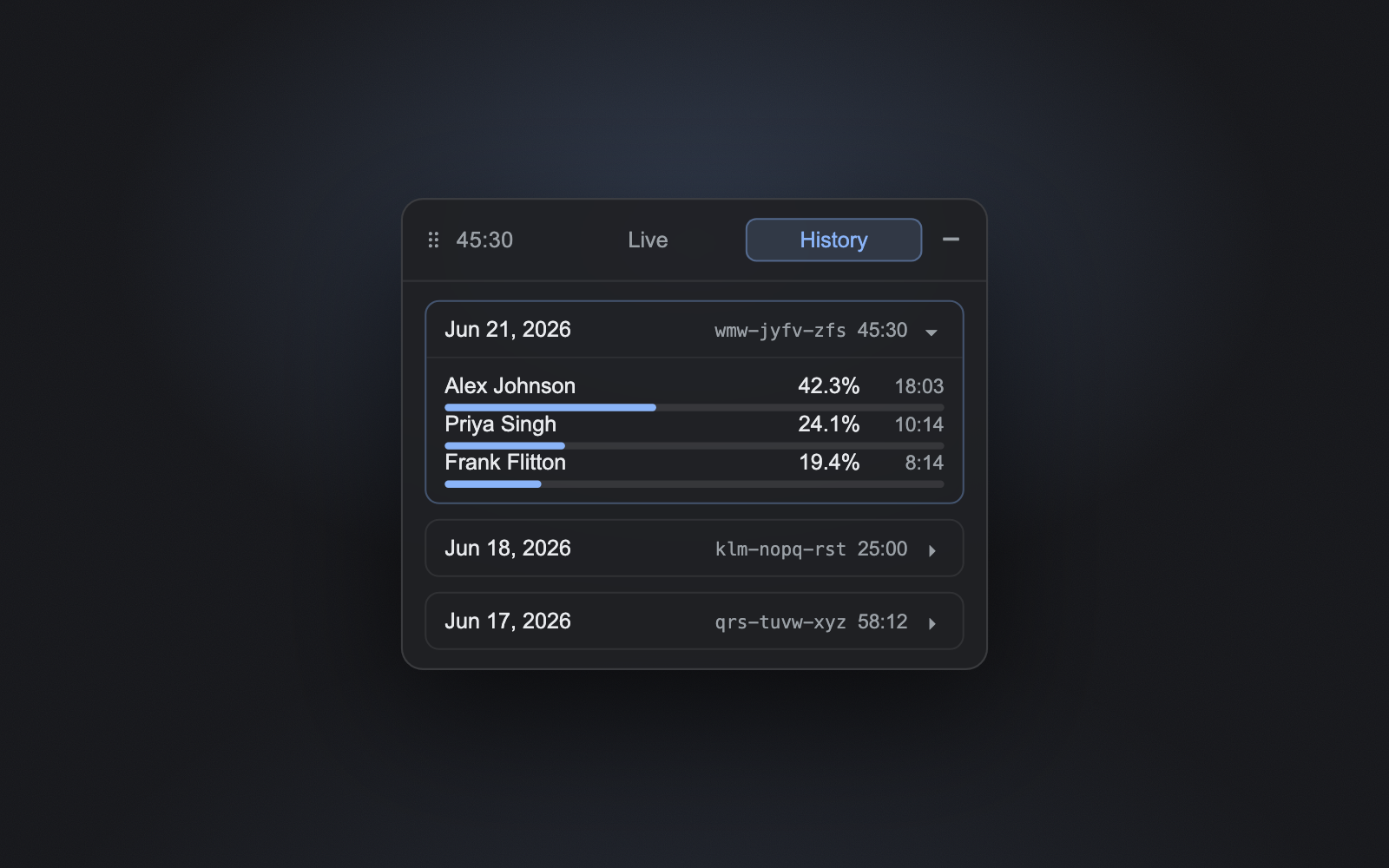
- Local only. A short summary of each meeting is kept in
chrome.storage.local, capped at the 20 most recent, so the history lives on the user's machine and never leaves it. That made the product honest by construction — there's no server to send anything to.
It's built with TypeScript and Vite, bundling all JavaScript into the
package (no remotely hosted code, no eval). Even the branding pipeline is
reproducible: icons, screenshots, and promo art all render programmatically from
HTML templates via headless Chrome, rather than being hand-exported.
The result
Airtime turns an invisible meeting dynamic into something you can act on while it still matters. Facilitators get a fair-share read of the room without playing referee; individuals get a quiet, private gauge of their own airtime; and the quieter perspectives that usually get crowded out have a much better chance of being heard.
The product's whole idea is compressed into a single glyph for the icon: three participant segments against a blue gradient, with an amber fair-share tick that the largest talker overshoots.